When it comes to AI assistants, first impressions are incredibly important. Interact and converse with one, and you’ll quickly determine whether it’s more of a hindrance than a source of expert help with its information and answers.
We expect AI assistants to be experts—grounded in business and domain logic—and to excel at delivering relevant responses. Yet, despite their increasing ubiquity, they are far from homogeneous, and significant challenges remain.
Half the battle is building the right context for the model so it can deliver responses that delight customers with speed, accuracy, and relevance. The other half lies in the AI itself: Whether it’s a generic pre-trained model, a domain-specific model, or a combination of neural and generative AI (GenAI) models, these systems must handle the many ways questions can be asked and reason their way to the right answer.
For AI assistants used in networking, it is especially important that they can identify patterns of outages or degradations by analyzing multivariate telemetry time series data and logs from disparate systems.
These are non-trivial problems to solve, as we know from experience. With access to hundreds of billions of daily data points and more than 15 years of networking domain experience, we’ve delivered the Cisco AI Assistant integrated into the ThousandEyes platform.
What To Look for in an AI Assistant
As you look to incorporate AI assistants into your operations, there are three non-negotiables that your chosen assistant should be capable of:
- Domain intelligence and deductive reasoning to answer the why, not just the what
- Data access for accurate correlation to solve the hardest issues across on-prem and cloud with contextual relevance and low latency
- Domain intelligence codified behind the model and the prompt to correlate outage patterns and degradations
Unlock the Why With Deep Domain Expertise
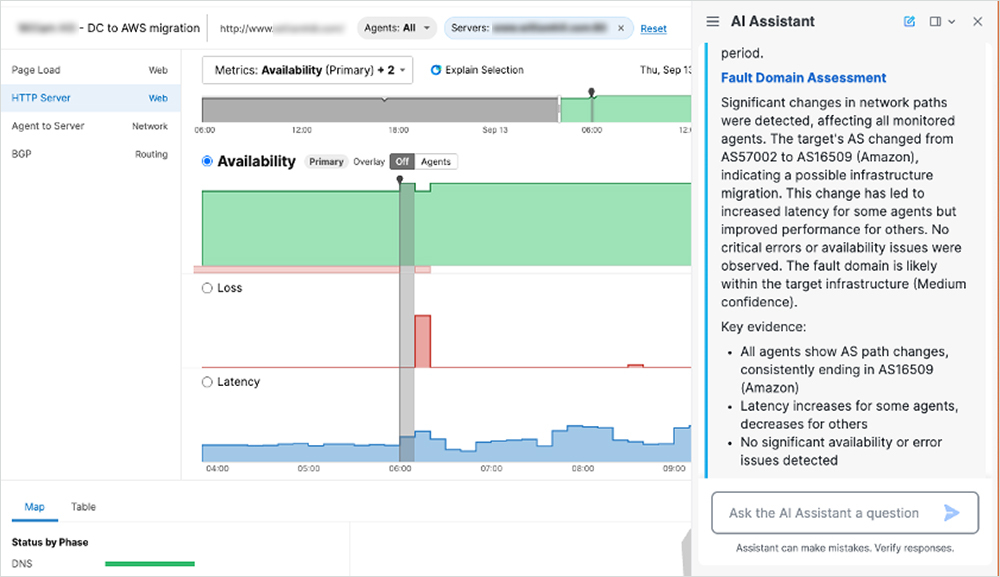
The Cisco AI Assistant’s ability to answer the why—not just the what—is powered by deep domain expertise and years of experience delivering network intelligence across enterprise, cloud, SaaS, and Internet networks. Drawing on this background, we harness and interpret petabytes of data accurately per day, creating clear context and a comprehensive, real-time picture of any degradation or disruption. This combination helps ensure that our models have access to the right data at the right time to perform impact analysis and fault domain attribution.
We have drawn on our extensive experience assuring performance to evolve test views from simple data presentation to intelligent data interpretation. This advancement accelerates fault domain isolation and reduces both mean time to innocence (MTTI) and mean time to resolution (MTTR) from hours to seconds.
Uncover Root Causes in Networks Owned and Unowned
Data access for accurate context is essential to solve the hardest issues across on-prem and cloud environments with relevance and low latency.
With access to the right data and context, the Cisco AI Assistant helps customers instantly identify application or service impact using algorithmic features like Alerts, Event Detection, and Internet Insights. These capabilities empower our users to operate like experts, enabling accelerated troubleshooting, immediate insights, and automated actions.
The Cisco AI Assistant integration into ThousandEyes is built with comprehensive data access in mind, allowing all users to quickly uncover buried insights in real time and identify the root cause of issues.
Predict Enterprise, Cloud, and Internet Outages
To move beyond surface-level answers, AI assistants must incorporate domain intelligence that is codified within both the model and the prompts. The Cisco AI Assistant achieves this by combining domain-specific and task-specific, fine-tuned GenAI models with potential signals from advanced anomaly detection using neural networks and time series diffusion models. As a result, the Cisco AI Assistant can predict, detect, and correlate outages and degradations across complex environments.
This capability gives customers clear, actionable reasoning for isolating fault domains and taking preventive measures—enabling them to respond to incidents more effectively and proactively.
As organizations face increasingly complex network environments and rising user expectations, the need for an intelligent, reliable AI assistant has never been greater. Cloud, SaaS, and the Internet have redrawn the boundaries of IT. Performance now depends on infrastructure you don’t always own—but when something breaks, you’re still responsible. Evaluating an AI assistant comes down to its reasoning capabilities across the entire digital supply chain that powers services and applications your customers rely on.
I’m incredibly proud of the standout work of the ThousandEyes team, bringing decades of domain expertise and harnessing unmatched access to network data to deliver advanced contextual reasoning in the Cisco AI Assistant for ThousandEyes. This unique combination empowers your teams to quickly pinpoint issues, unlock their root causes, and take decisive action—moving from reactive troubleshooting to proactive, predictive operations.