In an earlier blog, we explored how Cisco ThousandEyes provides automated assurance for AI applications. In this installment, we transition from monitoring to imagination.
Open a traditional network monitoring tool, and you see tables, charts, and timelines. The visuals are designed for effective data analysis and troubleshooting by technical practitioners. But show a VP of Retail Operations a jitter distribution chart and ask whether their 300 flagship stores can sustain point-of-sale transactions during peak holiday traffic, and you may lose them before the axis labels load.
This is a problem Cisco ThousandEyes is designed to solve. The challenge has never been whether Cisco ThousandEyes has the data: It has path visualization, endpoint/device agent telemetry, Internet Insights, Cloud Insights, anomaly detection, network synthetics, Cisco Real Speed and dozens of additional test types that (when combined) create a highly comprehensive view of your digital experience. The challenge has been making that data available to every role, in their operating language and at the speed business decisions demand.
In this blog we use Cisco ThousandEyes to showcase the art of the possible when building digital twins. Digital twins serve as an operational model of a physical environment (fed by live telemetry) that makes complex network data legible to anyone who navigates through the space. Whether it’s a home, a corporate office, or a hospital floor, when the data lives inside a context people already understand, no training is required. No terminology to learn. Just “aha” moments that inspire action.
The Cisco ThousandEyes Model Context Protocol (MCP) server is what makes this possible (at scale). It is used to provide the live data bridge between Cisco ThousandEyes and the 3D environments that assist technical and non-technical roles in making business-critical decisions. More information on the Cisco ThousandEyes MCP server can be found here.
Scenario 1: The Home is Where Many Experiences Converge
The modern home is no longer just a residence. It now serves as a convergence point for experiences that carry fundamentally different expectations.
-
Entertainment: A family gathered for a championship watch party is streaming the game in 4K, while a group of teens are mid-match in a competitive online game where 15 milliseconds of added latency is the difference between a win and elimination. Buffering during the fourth quarter creates an eruption of frustration in the living room. A lag spike during a ranked match is a loss that the household (and the Internet via poor customer sentiment) hears about for days. The stakes are emotional and represent a common reason a frustrated subscriber calls their provider, complains (possibly churns) and is the most visible measure of whether the network is delivering the experience that was promised.
-
Remote Work: A senior account executive is delivering a live product demonstration & business value readout (the final step in a six-month sales cycle). The deal is worth seven figures. A frozen screen during the key workflow, dropped audio during the pricing discussion, or untimely lag does not just complicate the call; it jeopardizes the quarter.
-
In-Home Health Services: A minor child cardiac patient is enrolled in a remote monitoring program that is connected to a cardiologist via a real-time Tele-Health video consultation. The vital signs monitor streams continuously. A network interruption in this environment is not an inconvenience; it is a clinical safety event and possibly triggers (unnecessary but) costly medical facility visits and turns a sensitive family situation into something untenable.
As we transition through each use case, the stakes escalate while the underlying dependency remains the same; the home network. We built a digital twin of this home as a navigable 3D environment rendered in a browser and powered by Cisco ThousandEyes data delivered through MCP.
The home environment comprises two floors and a basement with rooms laid out with real-world proportions. The Wi-Fi router sits at a known position with animated signal rings. Each room contains smart devices leveraging wireless connectivity; a vital signs monitor in the Tele-Health Care Room, a streaming TV in the living room, and a variety of sensors in the basement. A drone is used to showcase movement throughout the house to visualize signal strength, throughput, and connection quality derived from Cisco ThousandEyes telemetry.
Figure 1: Digital twin of the broadband subscriber home
Outside the home, a holographic BEAD/RDOF compliance badge displays download/upload speeds, measured latency against the 100 ms threshold, and FCC 100/20 Mbps minimum verification. Compliant or not, the program manager gets their answer in a glance.
Figure 2: View of Regulatory Compliance
The Cisco ThousandEyes MCP server supports over 30 tools to power the experience:
Figure 3: View of enabling Cisco ThousandEyes MCP server and viewing available tools in an AI coding assistant
The emotional center of this build is the Tele-Health Care Room. A hospital bed. A vital signs monitor with a Wi-Fi signal indicator. A pulse oximeter. A blood pressure monitor. The room reads -52 dBm at 285 Mbps and is rated “Fair.” The combination of Cisco ThousandEyes MCP Connected Devices and Endpoint Agents tools to retrieve time-series data from Cisco ThousandEyes including (but not limited to); network performance, web experience and wireless signal quality metrics measured directly from the devices inside the home providing enhanced visibility that matters.
Figure 4: View of subscriber experience from the Tele-health room
For the network engineer, that is a data point. For the healthcare administrator, whose patient is connected to a cardiologist via video, it is the answer to a critical question: “Does this patient’s home network meet the reliability threshold for continuous remote monitoring?” The in-home health services scenario is not hypothetical; it is one of the fastest-growing segments of Tele-Health, and the assurance gap is real. Cisco ThousandEyes data delivered through MCP can help to close it.
Scenario 2: Where Infrastructure Uptime Meets Investment Strategy
Jared is the Head of Facilities Management for 400 corporate locations. His KPIs are occupancy efficiency, environmental comfort, and infrastructure uptime. His CIO reviews the same real estate portfolio through a different lens. She tracks Experience Scores (comprising of Wi-Fi & Collaboration Health along with overall network performance) across every building as these metrics directly influence budget allocation for the hybrid work policy, technology refresh cycles and real estate investment decisions. Both need Cisco ThousandEyes data, and the Cisco ThousandEyes MCP tools simplify their access to actionable metrics.
This digital twin scenario leverages the One Cisco framework to showcase where Cisco’s portfolio delivers greater value as an integrated system. Navigating to the immersive view button (shown in Figure 5) for Building 001 showcases what happens when networking infrastructure, collaboration devices, and experience assurance operate as a unified system with Cisco routing and switching, Webex by Cisco on every conference room wall, and Cisco ThousandEyes tying the experience story together.
-
Embedded Transparency: Metrics carry a colored indicator.
-
Green reads “ThousandEyes · MCP Available”—this data is sourced live through the Cisco ThousandEyes MCP endpoint.
-
Blue reads “ThousandEyes · Simulated”—the data structure matches what Cisco ThousandEyes provides, but the current build uses representative values.
-
This transparency is deliberate. It tells every stakeholder exactly where the agentic operations integration stands today, what is possible now, and what the roadmap looks like. When a badge turns from blue to green, that is a real milestone.
-
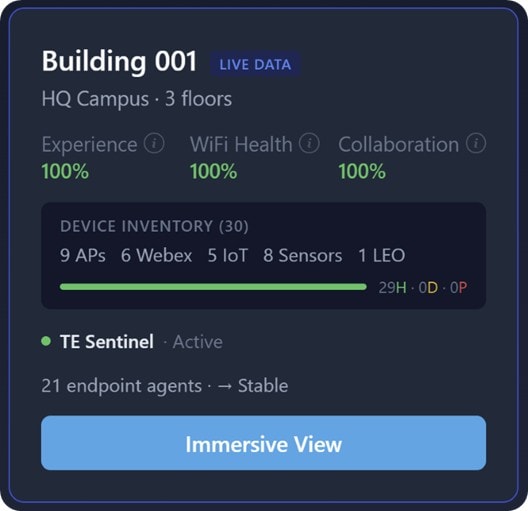
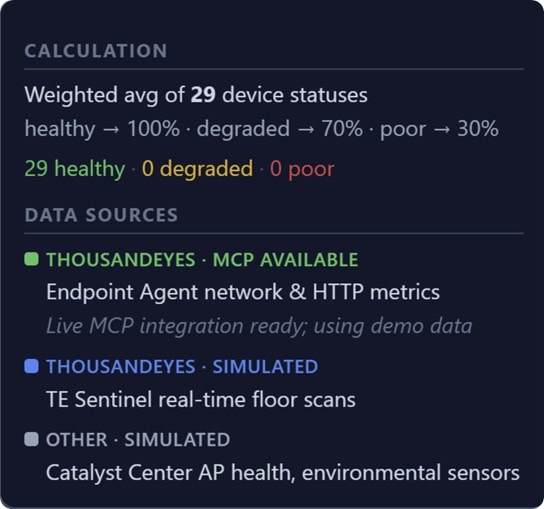
Figure 5: Showcases the per-site metrics along with tooltips for calculation details and provides a transparency matrix
Figure 6: High level visual of Bldg 001
Inside the office, a wall-mounted screen renders a world map with Cisco ThousandEyes Internet Insights outage data. The data is pulled via Cisco ThousandEyes MCP Outages tool. Outage dots glow proportional to impact. A sidebar lists the top active outages by provider. A pulsing LED reads “LIVE.” Every visitor to the building has immediate insight into the state of the Internet relative to the apps they care about. When the CIO sees this view during a quarterly review, she immediately gets the answer to “is the experience issue in Building 001 our problem or the Internet’s problem?” Same data, different operational lens; both answered without a single CLI command.
Figure 7: Internet Insights Outage Map
Every experience issue is not the result of an outage. Where there is degradation the proactive measurement data provided by Cisco ThousandEyes and combined with the telemetry from the One Cisco architecture allows for meaningful advancement in operational KPI’s such as mean time to identify, resolve and communicate using modern agentic operational methods.
Figure 8: View of Agentic Remediation
Achieving a common architecture & operating language for organizational insight
Both digital twin scenarios address different problems but share a common theme:
-
MCP provides the data bridge. Cisco ThousandEyes tools are invoked through a standardized protocol
-
Cisco ThousandEyes provides the operational truth. Endpoint agents, path visualization, Internet Insights, anomaly detection; the data types are consistent regardless of how they are rendered. The same telemetry that a network engineer queries in the Cisco ThousandEyes platform is the data that appears inside a 3D hospital room or a corporate lobby.
-
The digital twin provides the translation layer. It converts operational telemetry into a context that non-technical roles already understand: a home, an office, a building. No training required or advanced terminology to learn. Just answers via visual cues aligned with day-to-day business operations.
-
MCP accelerated the development itself. Both projects were built with an AI coding assistant connected to the Cisco ThousandEyes MCP server. The assistant could discover available tools, query live data, and generate visualization code informed by real API responses; collapsing what would have been weeks of API integration into hours of iterative prototyping. The protocol that powers the end product also powered its creation, allowing customers to bring their ideas to reality faster than ever.
-
That last point deserves emphasis. When the same protocol that serves your end users also accelerates your development team, the return on investment compounds. For organizational leaders evaluating MCP adoption, the development velocity story is as compelling as the operational one.
-
Cisco ThousandEyes MCP Server is GA
The digital twin is a fundamentally different way to consume operational data. One where the tool interface disappears and the context does the work. A government compliance officer does not need to learn network terminology to verify that a BEAD-funded market (and its households) meets its service obligation. A CIO does not need to open a CLI or navigate a complex GUI interface to understand why collaboration scores are declining in a specific building. A healthcare administrator does not need to interpret a signal-to-noise ratio to know whether a patient’s home network can sustain a cardiac monitoring session.
This is what happens when Cisco ThousandEyes data meets the right delivery mechanism. The data has always been there; path visualization, endpoint telemetry, Internet Insights, anomaly detection. Comprehensive, precise, and continuously updated from vantage points around the world. What changes with MCP and digital twins, is who can act on it. This expands the audience from the network engineering team to the line of business owners.
Every industry with a physical environment and a digital dependency (e.g. retail stores, manufacturing floors, university campuses, financial trading floors, logistics hubs, etc.) can benefit from the same architectural pattern: Cisco ThousandEyes data, delivered through MCP, rendered in a context that the decision-maker already understands.
The best way to understand the value is to experience the data firsthand. Cisco ThousandEyes offers a free trial that gives you immediate access to the same endpoint agent telemetry, path visualization, and Internet Insights capabilities that power the digital twins described in this series. Start assuring your own environment (your home network, your office infrastructure, your cloud application paths) and see what becomes visible when Cisco ThousandEyes data meets the context where your decisions are made.
About Cisco
Cisco (NASDAQ: CSCO) is the worldwide technology leader that securely connects everything to make anything possible. Our purpose is to power an inclusive future for all by helping our customers reimagine their applications, power hybrid work, secure their enterprise, transform their infrastructure, and meet their sustainability goals. Discover more on The Newsroom and follow us on X at @Cisco.