What if the biggest opportunity for AI in network operations isn’t replacing human decisions—but helping engineers make better ones?
When an application slows down or users lose connectivity, experienced NetOps teams usually know how to investigate. The challenge is getting to the right evidence quickly. An engineer may need to move across alerts, telemetry, network paths, application performance, cloud dependencies, and Internet conditions before they can determine what changed and where to focus.
AI has the potential to collapse much of that work. Instead of manually gathering and correlating information, engineers can start with a question. AI can retrieve relevant data, connect signals across domains, identify patterns, and surface supporting evidence, giving the operator more context to make the decision.
But there is a catch. AI can only reason from the operational context it can access. If that context stops at the edge of the enterprise network, AI may miss the cloud, SaaS, service provider, or Internet dependency actually affecting the experience. And if the evidence cannot be trusted or validated, faster reasoning does not necessarily produce better decisions. This is where assurance becomes foundational to AI-assisted operations.
Cisco Assurance provides the experience and performance intelligence AI needs to understand what is happening across the complete digital experience, helping NetOps teams use AI to investigate faster, make more informed decisions, and ultimately build the foundation for more autonomous operations.
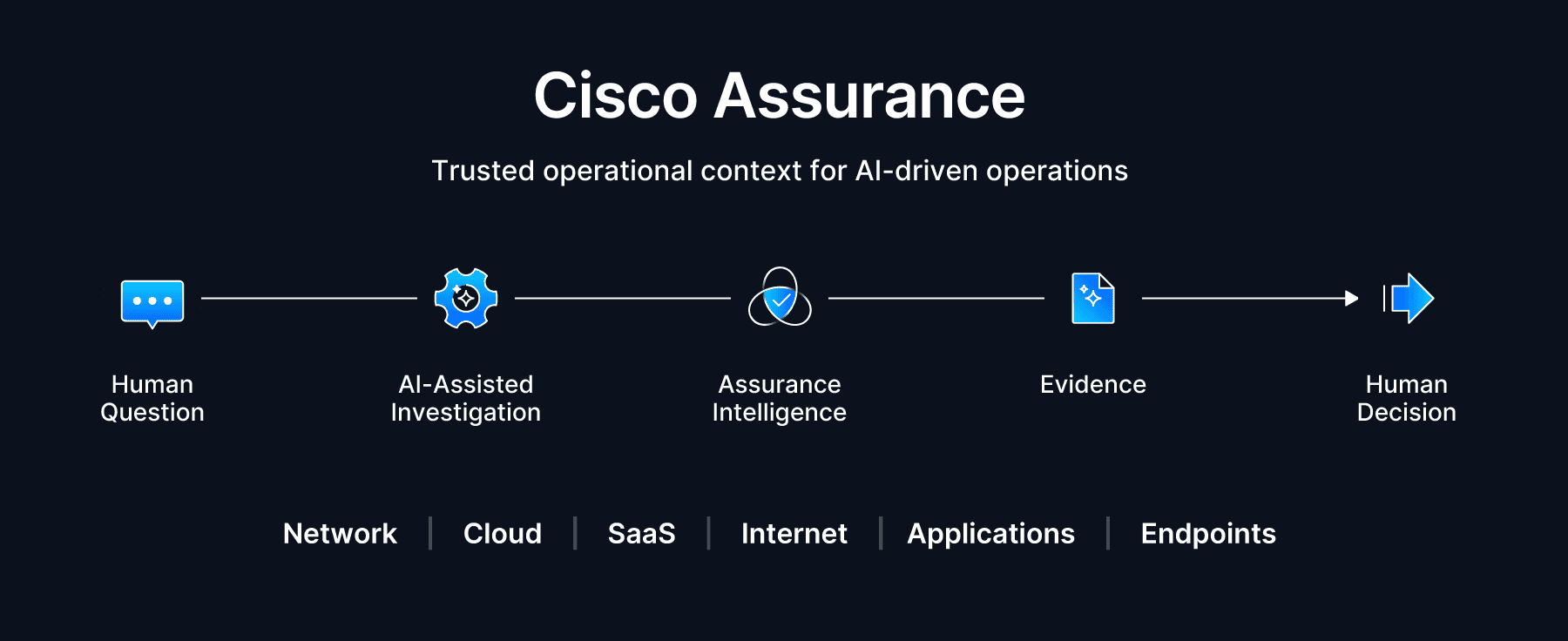
From Searching for Data to Investigating with AI
Consider a familiar scenario: users at a branch report that an application is slow. A network engineer may need to identify which tests cover the application, examine alerts during the affected time period, compare current performance against expected behavior, inspect network paths from several locations, and determine whether a routing change, provider issue, cloud dependency, or application problem occurred at the same time.
None of these tasks is particularly difficult on its own. The challenge is the time and expertise required to perform them together. This distinction is important: Much of troubleshooting is not decision-making. It is information gathering.
AI can increasingly perform that retrieval and correlation work on behalf of the operator. In the Cisco ThousandEyes AI-Assisted Operations Design & Deployment Guide, an engineer can describe a symptom while an AI assistant retrieves relevant ThousandEyes data, correlates the results, and presents a characterization of the issue with supporting evidence. The engineer retains responsibility for deciding what should happen next.
That changes the role of AI in NetOps. AI does not have to replace the network engineer to deliver significant value. It can scale the network engineer’s ability to understand the environment and make informed decisions. And that is an important first step toward agentic operations.
Why AI Needs Assurance
Large language models are remarkably good at reasoning over information. But operational reasoning is only as useful as the context available to the model.
A digital experience can depend on the campus or branch network, WAN, cloud infrastructure, SaaS platforms, service providers, DNS, CDNs, and the Internet. A problem in any one of those domains can affect the user. If AI sees only part of that service-delivery path, it is reasoning from an incomplete picture. This is where Cisco Assurance becomes increasingly important.
Cisco Assurance provides continuous experience and performance intelligence across owned and unowned environments. ThousandEyes extends that intelligence across enterprise networks, cloud, SaaS, service providers, and the Internet, helping teams understand not only that experience has degraded, but where along the service-delivery path conditions changed.
For AI-assisted operations, that intelligence becomes operational context. The difference matters. An AI assistant that knows an application is slow can offer possibilities. An AI assistant that can see a latency increase along a specific network path, correlate it with a path change, determine whether other locations experienced the same behavior, and examine related alerts can help an engineer conduct a much more focused investigation.
The objective is not for AI to make unsupported declarations about root cause. In fact, the ThousandEyes design guidance recommends treating assistant output as a characterization supported by evidence rather than an unquestioned root-cause determination. AI can accelerate reasoning. Assurance gives that reasoning something trustworthy to work with.
Give AI the Right Way to Access Operational Intelligence
Not every AI-assisted workflow requires the same interface. The ThousandEyes architecture supports three complementary access planes: native AI, Model Context Protocol (MCP), and APIs. Each reaches the underlying ThousandEyes intelligence but serves a different operational purpose.
Native AI is best suited to helping an engineer understand information already available within the ThousandEyes experience.
MCP supports interactive, multi-step investigations that need to move across objects, data sets, or time windows.
APIs are better suited to deterministic, repeatable, and unattended workflows where consistent output matters.
The principle is straightforward: Use AI where reasoning adds value. Use deterministic automation where it does not.
For example, “Why is the branch slow right now?” is exploratory and well suited to an MCP-powered investigation. A nightly export of test results is a repeatable data operation better handled through an API. The design architecture intentionally treats these interfaces as complementary rather than competing approaches.
This distinction becomes increasingly important as organizations operationalize AI. The objective should not be to insert a language model into every workflow. It should be to apply AI where it can augment human reasoning while preserving predictable automation where consistency matters more.
AI Assistant: Start with the Question
One of the most immediate changes AI brings to NetOps is a simpler way to interact with operational intelligence.
With the Cisco AI Assistant, operators can use natural language to investigate operational questions and access relevant information without beginning with a dashboard, query language, or specific product workflow.
Instead of asking: Which dashboard do I open?
The engineer can begin with:
What changed?
Where are users being affected?
Is this isolated to this site?
What should I investigate next?
This changes the interaction model from navigating toward an answer to starting with the operational question.
For experienced engineers, AI can reduce repetitive information gathering. For newer engineers, it can provide a more intuitive way to access expertise and operational context. In both cases, AI becomes a force multiplier for human expertise rather than a substitute for it.
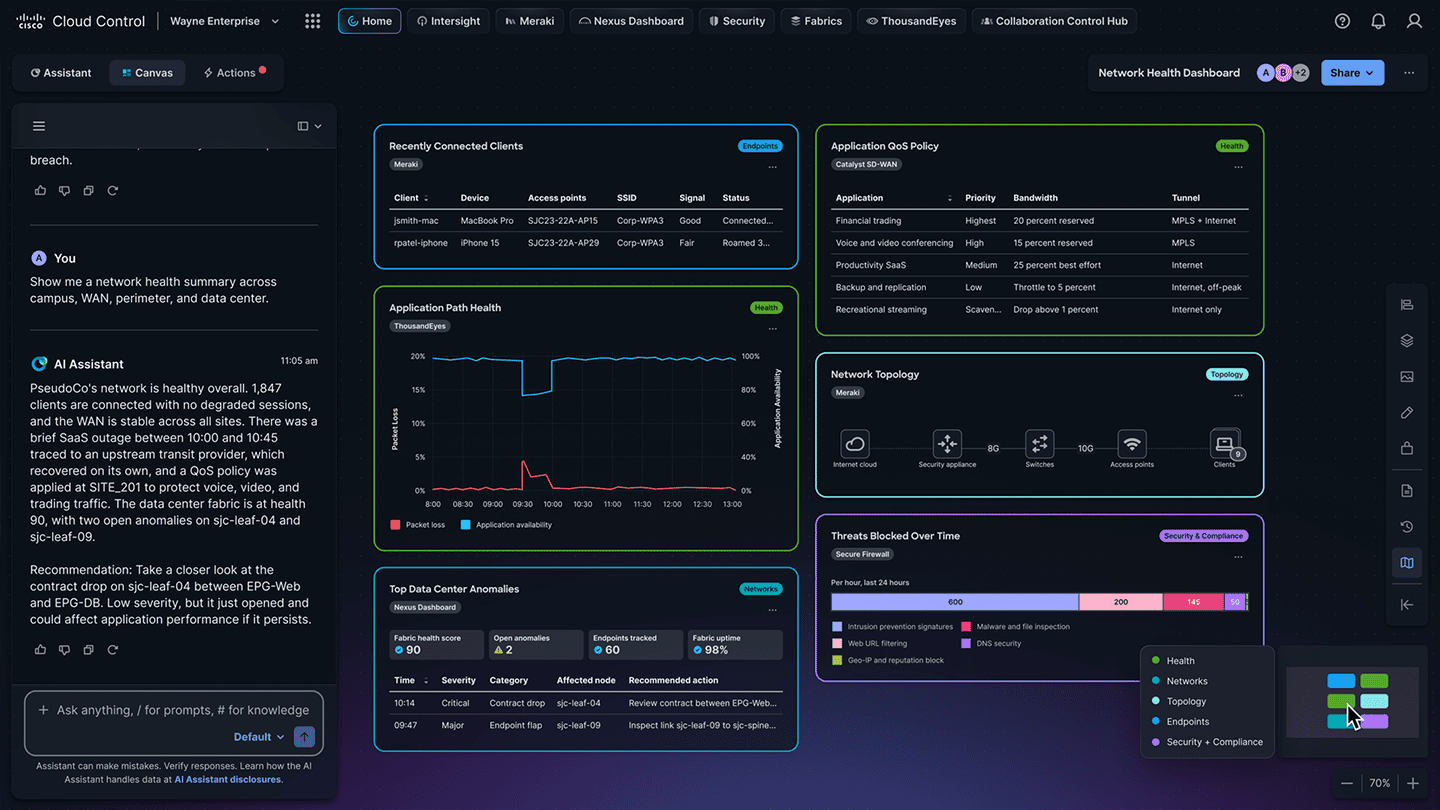
Cloud Control: Bring Assurance Intelligence into Context
Natural language interaction is only part of the opportunity.
Many of the hardest operational problems happen to cross domains. An application experience issue may involve the campus network, WAN, Internet path, cloud infrastructure, security policy, or even an application itself. Yet the information needed to understand those relationships has traditionally lived across different operational tools.
Cisco Cloud Control creates an opportunity to bring that context together. ThousandEyes assurance intelligence becomes available alongside intelligence from other Cisco products, giving teams a more complete, end-to-end picture of whats happening across the digital experience.
Instead of investigating network and Internet conditions separately, operators can use ThousandEyes intelligence as part of a broader Cisco operational context.
That changes the question from: What does this individual system see?
To: What is happening across the environment, how is it affecting digital experience, and what evidence can help us understand why?
For AI, this broader context is critical. The more complete the operational picture, the better equipped AI becomes to help operators narrow an investigation and make informed decisions.
AI Canvas: Investigate Across Domains
Some operational questions cannot be answered in a single prompt. They require multiple steps, additional evidence, collaboration across teams, and the ability to preserve context as an investigation develops.
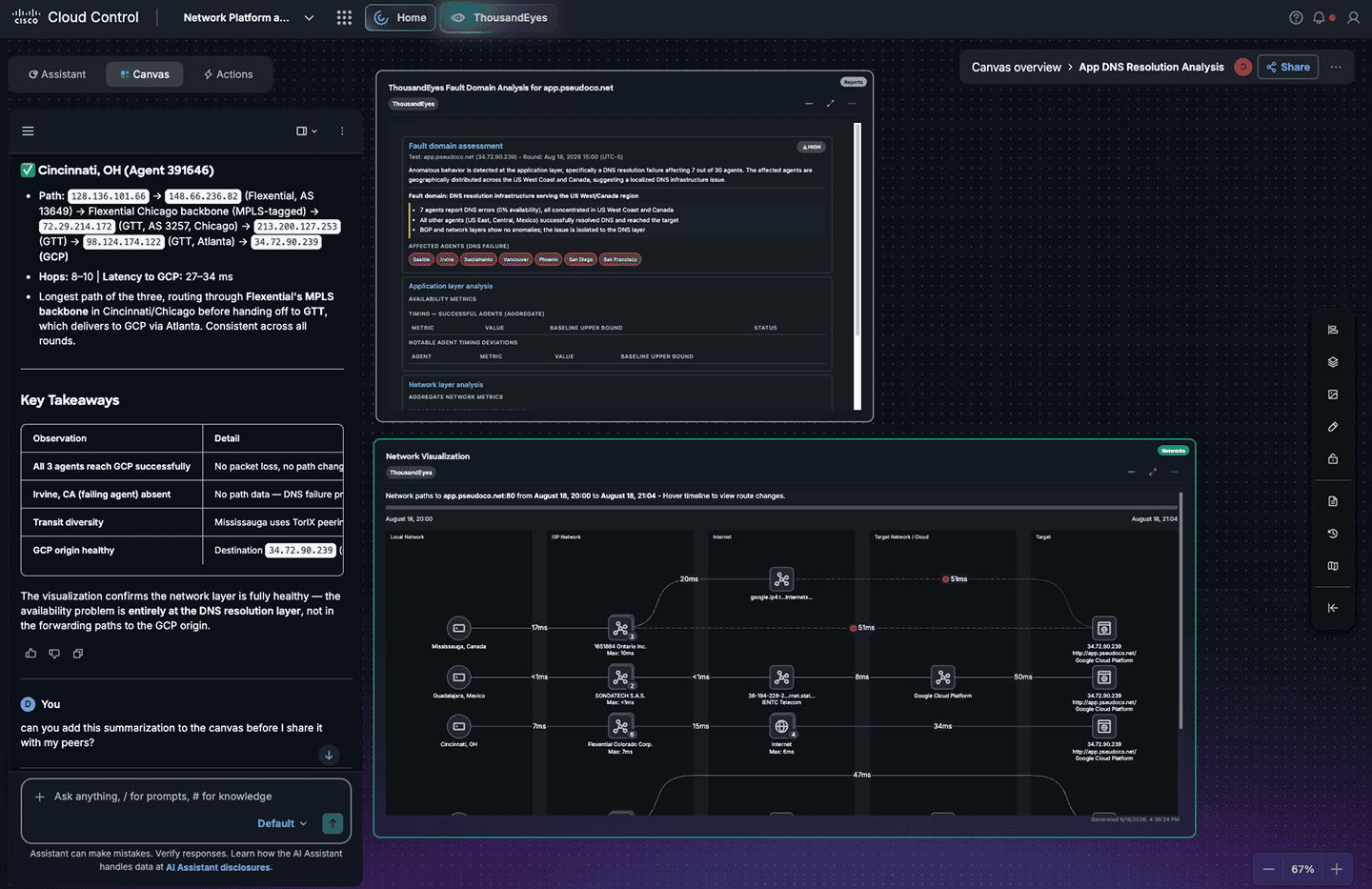
Cisco AI Canvas provides a collaborative workspace for these more complex investigations. ThousandEyes brings alerts, path intelligence, endpoint insights, and experience context into these workflows, helping NetOps teams investigate across both owned and unowned environments without treating Internet and external dependencies as a separate troubleshooting exercise.
As an investigation evolves, AI Canvas keeps the relevant context, evidence, and expertise together, giving operators and AI agents a shared workspace to understand the issue and determine what comes next. The result is more than faster access to information. It creates a shared operational context in which people and AI can work through an investigation together.
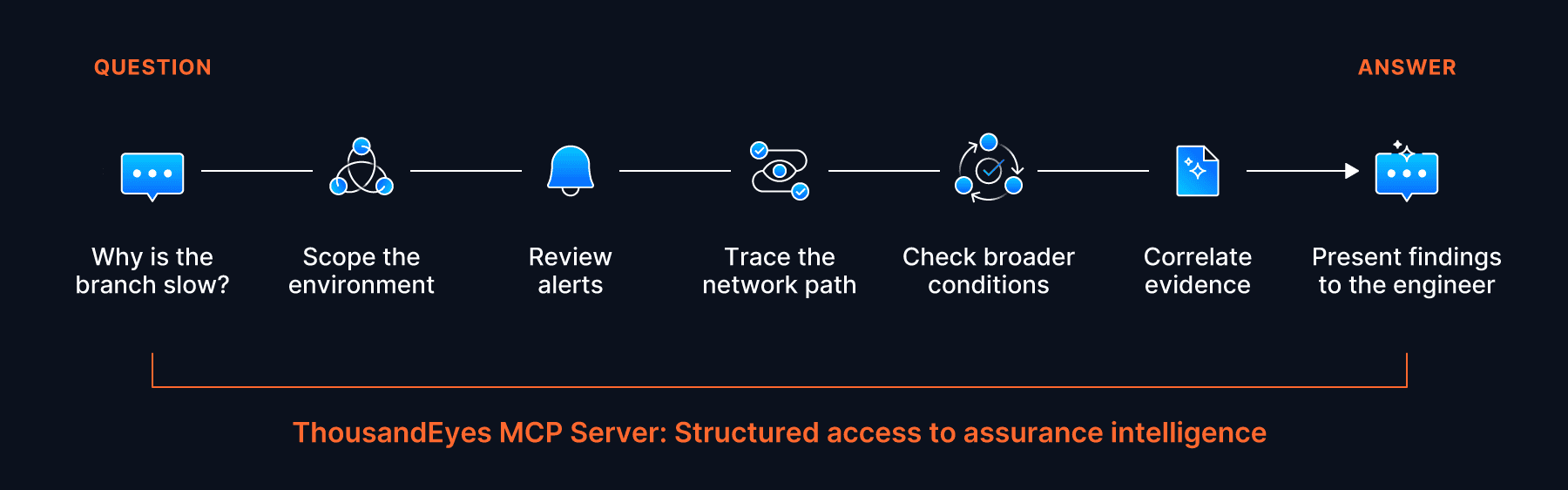
ThousandEyes MCP Server: Extend Assurance Intelligence to the AI Ecosystem
Let’s face it, organizations will not operate exclusively through a single AI experience. Enterprises are adopting AI assistants, developer environments, agents, and operational workflows across their technology environments. Assurance intelligence therefore needs to be accessible to the broader AI ecosystem. The Cisco ThousandEyes MCP Server provides that bridge.
Model Context Protocol provides a standardized way for compatible AI clients to interact with external data and capabilities. The ThousandEyes MCP Server exposes ThousandEyes intelligence through a Cisco-hosted remote endpoint, allowing AI clients to access operational data using structured tools.
The opportunity goes well beyond asking questions about a dashboard. The MCP Server exposes roughly 50 tools across 12 functional groups, spanning areas including core monitoring, network path analysis, endpoint monitoring, Cloud Insights, advanced analysis, dashboards, agents, and account management.
Having so much insight allows an AI assistant to combine those tools as an investigation develops. Instead of an engineer manually moving between multiple ThousandEyes views, the assistant can begin by establishing scope, retrieve relevant alerts, examine network paths, check broader conditions, and progressively gather the evidence needed to characterize the issue. The design guide specifically recommends narrowing scope before retrieving detailed results so the model works with focused context. This is an important evolution. MCP moves AI-assisted operations beyond “chat with your data” toward coordinated investigation.
Faster Investigation Does Not Mean Giving Up Control
Making operational intelligence available to AI creates another important question: What should AI actually be allowed to do?
AI-assisted operations should not mean giving an AI model unrestricted access to production infrastructure. The ThousandEyes MCP architecture establishes an important separation. In an MCP deployment, the AI client, not the language model, is the operational hub. The client holds the ThousandEyes credential, determines which tools are available, executes tool calls, and can enforce approval requirements. The language model does not directly hold the ThousandEyes token or establish a direct connection to the platform.
Existing permissions also continue to apply. Connecting an AI assistant does not automatically expand what an operator can access. The assistant operates within the permissions associated with the user’s credentials and account-group scope. Platform changes remain attributable through existing activity logging.
This enables an important principle for AI-assisted operations: AI accelerates the investigation. Humans remain accountable for the decision.
That distinction becomes even more important when moving from read operations to actions that modify platform state. The ThousandEyes MCP Server includes both read operations and tools capable of modifying tests, alert rules, dashboards, tags, templates, and other configuration. Cisco’s design guidance recommends exposing only the tools required for a particular operator or workflow and applying additional controls to higher-risk operations.
This gives organizations a practical way to adopt AI incrementally: begin by helping AI understand and investigate, then expand its role as governance, operational context, and confidence mature.
The Next Advantage in NetOps is Not More Data
Network operations teams already have enormous amounts of data. The next advantage will come from how effectively organizations transform that data into understanding, and how quickly that understanding can inform action.
AI changes the economics of that process. It can gather information faster than humans, correlate signals across larger data sets, maintain context across complex investigations, and make operational intelligence accessible through natural language.
But AI cannot reason over context it cannot see. That makes assurance more important, not less, as operations become more AI-driven. Cisco Assurance provides the experience and performance intelligence AI needs to understand what is happening across the digital experience.
The unified AI Assistant provides a natural-language way to access that intelligence.
Cloud Control brings ThousandEyes assurance intelligence into context alongside other Cisco product data.
AI Canvas provides a workspace where people and AI can investigate complex, cross-domain issues together.
And the ThousandEyes MCP Server extends that intelligence into the AI assistants, clients, and agents organizations choose to use.
Together, these capabilities establish the foundation for something much larger than faster troubleshooting. They create a path from human-led operations supported by AI toward AI-driven operations governed by humans.
AI-assisted operations is the beginning, not the destination The progression toward autonomous operations should not begin by handing control to AI. It begins by improving how AI understands the environment. First, AI helps engineers retrieve, correlate, and interpret operational intelligence. Then it helps characterize issues and recommend next steps.
As organizations establish the necessary context, permissions, guardrails, and validation mechanisms, AI agents can begin taking approved actions within defined boundaries. And as those systems become more autonomous, assurance takes on an even more important role: continuously determining whether those actions actually improved the experience they were intended to protect.
Because succeeding in the AI era will require more than making networks autonomous. It will require giving AI the context to understand the environment, the controls to operate within it, and the assurance to know whether its actions delivered the intended outcome.
Ready to put AI-Assisted Operations into practice?
AI-assisted operations starts with giving AI secure, structured access to the right operational intelligence. But access alone is not enough. The AI-Assisted Operations with Cisco ThousandEyes Design & Deployment Guide goes deeper into the architecture behind this model, including native AI, the ThousandEyes MCP Server, the v7 API, client configuration, access controls, and the path toward production-ready AI operations.
CTA: Start with the architecture. Build the context. Put AI to work with assurance.