AI is changing the role of network operations. The first wave of AI helped operators work faster. It summarized information, surfaced insights, correlated signals, and helped teams investigate complex problems. The next wave is going even further. AI agents can reason across operational data, recommend remediation, and increasingly execute approved actions within defined policies and guardrails.
That is an important shift. But it also changes what happens after an operational decision is made. When an AI agent takes action, completing the action can’t be the end of the workflow. NetOps still needs to know whether the action improved network or application performance, restored the user experience, and avoided creating unintended consequences somewhere else.
In AgenticOps, every action creates a new question: What happened next?
Action is No Longer the End of the Workflow
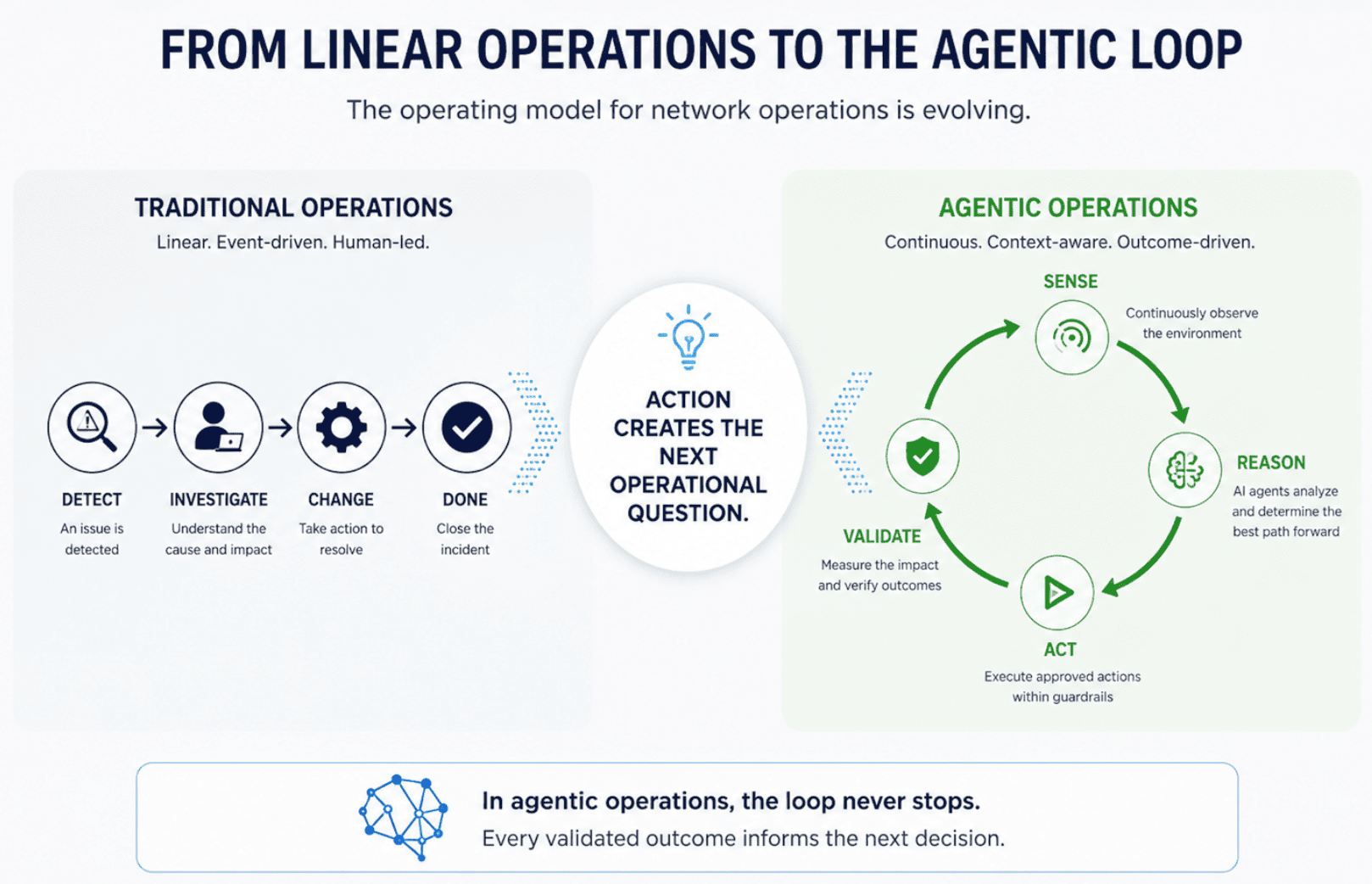
Traditional network operations are often built around a relatively linear process. Something goes wrong, an alert fires or a user opens a ticket, NetOps then investigates, a change is made, and the incident is eventually closed.
AgenticOps introduces a different model. AI agents can continuously consume operational intelligence, investigate changing conditions, reason about potential causes, and take approved actions. Once that happens, operations become less linear and more iterative. Validation matters because executing an action and achieving an outcome are not the same thing.
A configuration can be successfully applied while application performance remains degraded. Traffic can be rerouted without improving user experience. A remediation can solve one problem while creating another somewhere else.
As operational decisions happen faster, NetOps needs an equally fast way to understand their impact. Machine-speed action requires machine-speed assurance.
Execution Success is Not Outcome Success
Automation has traditionally relied heavily on confirmation from the system where the action occurred. An API returns a successful response. A configuration is accepted. An automation workflow completes without an error. Those signals matter, but they answer only one question: “Was the action executed?” NetOps needs to answer a different question: “Did the action produce the intended result?”
Consider an AI agent responding to application degradation by rerouting traffic. The network may confirm that the routing change was successfully applied, but that doesn’t tell the agent whether application response time improved or whether the new path introduced latency, packet loss, or another dependency problem.
Determining outcome success requires evidence from the environment around the action. Think about what we covered in the “Assuring the Agentic Ecosystem” blog found here.
That evidence could include:
User and application experience
Network connectivity and path performance
Application availability and response time
Cloud and SaaS dependencies
Internet routing and reachability
Synthetic test results before and after the action
This is an important distinction for agentic operations. An API can tell an agent that a change was executed. Assurance tells the agent whether it worked.
An API can tell an agent that a change was executed. Assurance tells the agent whether it worked.
Give AI Agents an Independent Source of Evidence
For AI agents to participate meaningfully in operations, they need more than access to the systems they manage. They need trusted operational context that helps them understand how those systems are performing.
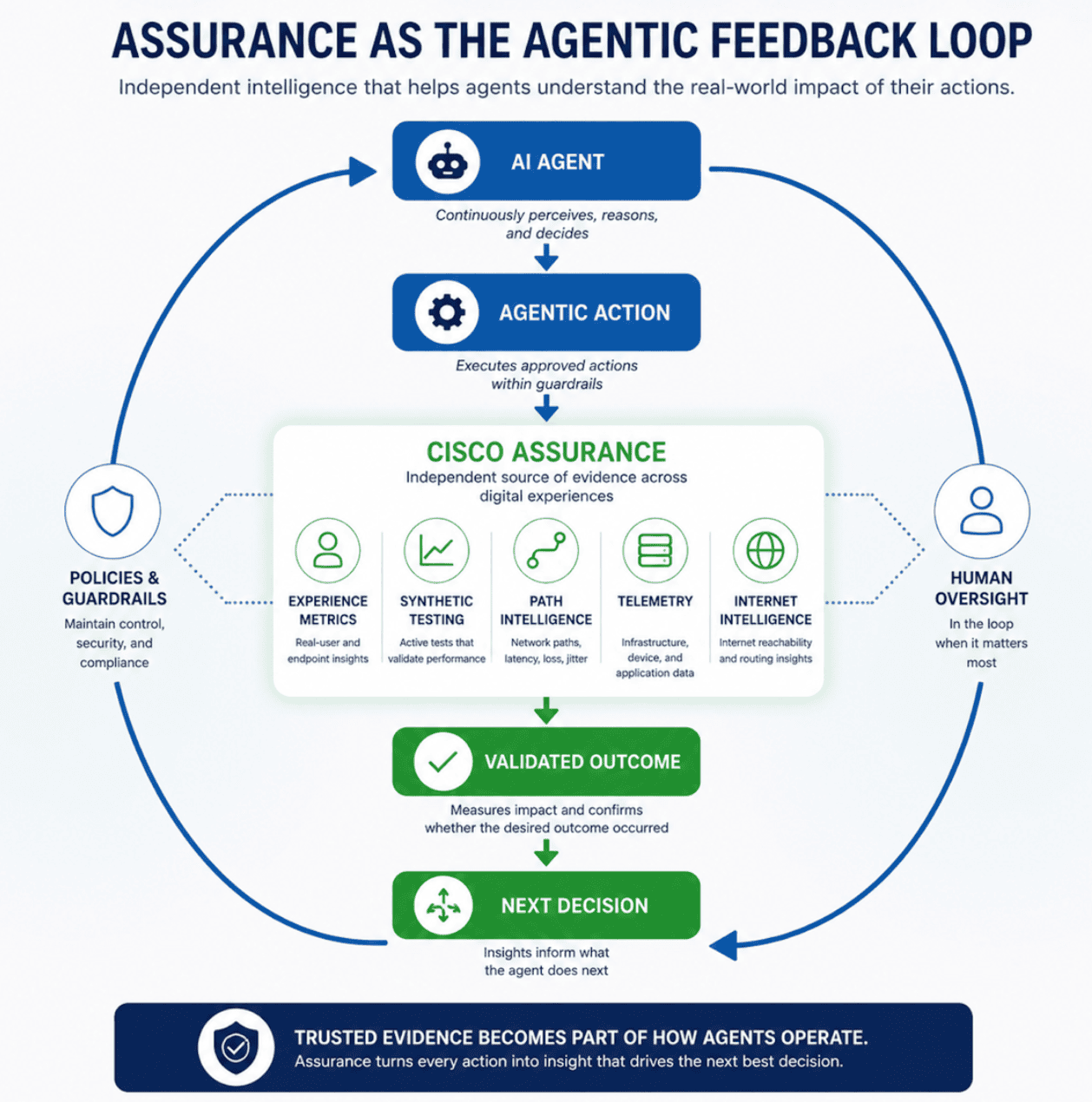
Cisco Assurance provides experience and performance intelligence across users, applications, networks, cloud services, SaaS platforms, and the Internet. Active testing, Experience Metrics, telemetry, path intelligence, and Internet intelligence provide multiple perspectives on what’s happening across the digital experience.
This becomes particularly important after an agent takes an action. That’s because, instead of relying solely on confirmation from the system that executed the change, the agent can use assurance intelligence to independently measure its impact. Did latency decrease? Did application availability recover? Did the affected path improve? Did user experience return to expected levels?
As assurance intelligence becomes accessible through APIs and the Model Context Protocol (MCP), it can also become directly available to AI agents as part of their reasoning and operational workflows. When this happens, assurance evolves from intelligence designed for people to interpret into intelligence that machines can consume and act on.
What happens when the action does not work?
This may be the more important question. Continuous Assurance is not simply about confirming successful outcomes. It provides evidence when an action fails to deliver the expected result.
Imagine an agent identifies the likely cause of an application performance issue and executes an approved remediation. Immediately afterward, synthetic testing shows that application response time has not improved. Path intelligence indicates that packet loss remains. Experience metrics continue to show degradation.
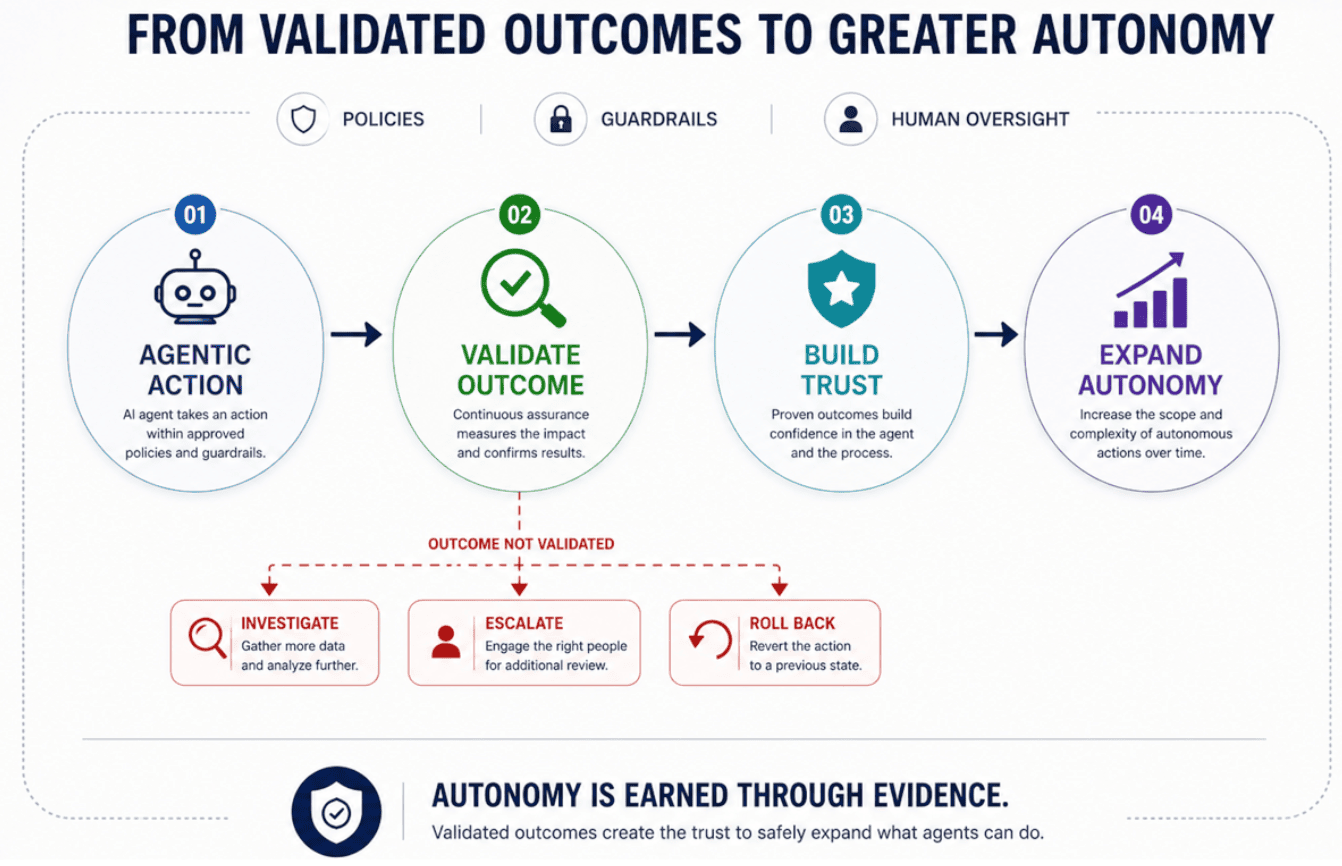
The workflow shouldn’t simply close because the action was successfully executed. The failed validation becomes new operational evidence. Based on the organization’s policies, permissions, and guardrails, the agent could then:
Continue the investigation using the new evidence
Execute another pre-approved remediation
Escalate the issue for human review
Request approval for a different action
Roll back the original change
This turns validation into more than a post-change health check. It becomes part of the operational control loop. The result of one action informs the next decision.
Continuous Assurance Changes the Role of Testing
Testing has traditionally been associated with troubleshooting, application development, or change validation. In AgenticOps, its role becomes broader. Continuous testing can establish an ongoing understanding of expected experience and performance before an agent acts. Targeted tests can then measure what changed immediately after an action.
For example, before an approved network remediation, Cisco Assurance can provide evidence about application response time, network latency, packet loss, path behavior, or service availability. After the action, those same conditions can be measured again. The agent now has a measurable point of comparison. Instead of assuming that a change improved conditions, the operational workflow can determine whether the expected outcome actually occurred.
This becomes increasingly important as the number and speed of agentic actions increase. We learn quickly that humans can’t manually validate every decision made at machine speed. Maybe the answer is that validation itself needs to become continuous.
Evidence Creates a Path to Greater Autonomy
Organizations are unlikely to move from human-controlled network operations to unrestricted autonomy in a single step. Nor should they. Autonomy can expand progressively.
An organization might initially allow an AI agent to recommend an action. Once teams gain confidence, the agent may be allowed to execute that action with human approval. Eventually, well-understood actions could operate autonomously within defined policies and guardrails. Continuous Assurance provides another important ingredient in that progression: evidence.
If a particular class of actions repeatedly produces the expected outcome, the organization gains measurable evidence that the workflow is behaving as intended. If validation repeatedly fails, the boundaries of autonomy can remain restricted or be reduced. This creates a more practical model for adopting autonomous operations. Trust does not have to be assumed. It can be earned through demonstrated outcomes.
Continuous Assurance Closes the AgenticOps Loop
The shift toward agentic operations is not simply about giving AI more operational responsibility. It is about redesigning operations around a continuous cycle of intelligence, action, evidence, and adaptation. That requires assurance to evolve as well.
AI agents need intelligence to understand what is happening before they act. They need independent evidence to determine what changed after they act. And they need continuous feedback to determine what should happen next.
Cisco Assurance brings those pieces together by continuously measuring experience and performance across the environments digital services depend on and making that intelligence available to people, workflows, and AI agents. The result is a closed operational loop, that includes sensing, reasoning, acting, validating, and adapting.
For NetOps teams, this creates the opportunity to move faster without giving up visibility or control. For IT leaders, it provides a more deliberate path toward autonomy, one where greater operational independence is supported by measurable evidence.
And for AI agents, Continuous Assurance provides something fundamental, a way to understand the consequences of their actions. Because in AgenticOps, taking action isn’t enough, the outcome has to be trusted.
See how Cisco Assurance provides the continuous intelligence and validation needed to close the AgenticOps loop and build toward trusted autonomous operations.